Every parent notices how quickly young children learn when they are curious and comfortable. One moment, they are pointing at everything, asking questions, and the next, they are remembering shapes, colours, and even letters without being formally taught.
In early childhood, learning doesn’t need to feel like “teaching” at all. In fact, the more natural and playful it is, the better children understand and remember. Simple daily moments at home can become powerful learning experiences when used the right way.
Instead of sitting children down for structured lessons, parents can introduce alphabet learning activities and learn colours for kids through everyday routines, games, and conversation. This approach helps build early language skills, strengthens memory, and supports school readiness without pressure. This guide shares five easy and enjoyable ways parents can teach letters and colours at home while naturally supporting Early childhood education.
1. Alphabet and Colour Hunt Around the House
Children love exploring their surroundings, making this activity both simple and highly effective. Parents can create a “hunt game” where kids search for objects based on letters and colours.
For example:
- Find something red that starts with B (Ball)
- Find something blue that starts with C (Cup)
- Find something yellow that starts with S (Spoon)
This activity strengthens Alphabet learning activities while reinforcing Colour recognition for children in a playful format.
Why it works:
- Encourages observation skills
- Builds vocabulary naturally
- Strengthens letter-colour association
Parents can repeat this game daily with new objects to keep children engaged.
2. Storytime with Colourful Alphabet Books
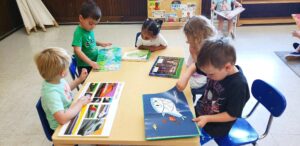
Reading together is one of the most powerful tools in early learning. Using visually rich books that combine letters and colours helps children connect symbols with meaning.
Books inspired by Educational books for toddlers and Children’s learning book formats often use objects, animals, and everyday items linked to each letter and colour.
During reading:
- Point to the letters and say them aloud
- Ask the child to identify colours on the page
- Repeat words slowly for better understanding
This method supports Literacy development and improves Visual learning for preschoolers, especially when repetition is used consistently.
3. Colour Sorting with Alphabet Objects
This activity turns learning into a hands-on experience. Parents can use coloured toys, blocks, or paper cutouts labeled with letters.
Steps:
- Mix objects of different colours
- Assign each letter a colour category
- Ask the child to sort objects accordingly
Example:
- A = Red Apple card
- B = Blue Ball card
- C = Green Car card
This strengthens both Learn alphabet and Learn colours for kids simultaneously.
Benefits:
- Improves cognitive association
- Enhances problem-solving skills
- Encourages independent thinking
Children learn best when they can physically interact with learning materials.
4. Creative Art and Colouring Activities
Art is one of the most natural ways children express themselves. Parents can design simple drawing sessions where each letter is paired with a specific colour.
For example:
- Draw “A” in red and decorate it with apples
- Draw “B” in blue and fill it with balloons
- Draw “C” in green with caterpillars
This method strengthens Alphabet learning activities while improving creativity and fine motor skills. It also supports Interactive learning for kids, making education feel more like play than instruction.
Extra Tip:
Encourage children to explain their drawings. This builds confidence and language development.
5. Daily Routine Learning Moments
One of the most effective strategies in Early childhood education is using daily routines as learning opportunities. Children don’t always need separate study time; they learn best in natural environments.
Parents can integrate learning into everyday activities such as:
- Naming colours during dressing (“This is your blue shirt”)
- Identifying letters on food packaging
- Counting and naming objects during mealtime
These small interactions reinforce both Learn alphabets and Learn colours for kids without overwhelming the child.
Why this method is powerful:
- Builds long-term memory retention
- Encourages continuous learning
- Strengthens parent-child bonding
The Role of Consistency in Early Learning
Children thrive on repetition and familiarity. When letters and colours are introduced consistently through different activities, they begin to recognize patterns more easily. This is a core principle in kindergarten readiness and early literacy development.
Parents should focus less on perfection and more on engagement. Using structured yet playful approaches inspired by educational picture books and Toddler educational resources can create a strong foundation for future academic success.
Conclusion
Teaching letters and colours at home does not require complex tools or formal lessons. With simple activities like hunts, storytelling, sorting games, art projects, and daily conversations, parents can build strong early learning habits naturally and enjoyably.
By combining Alphabet learning activities with Learn Colours for kids, children develop stronger memory, improved vocabulary, and better readiness for preschool and kindergarten.
For parents looking for structured support, Learn Alphabets and Colours with Me by Nishita Patel offers a thoughtfully designed approach that blends letters, colours, and visual learning into one engaging experience.
Make learning fun every day with simple activities that help your child recognize letters and colours naturally at home. Start building strong early learning habits today and support your child’s preschool readiness with playful, consistent practice.