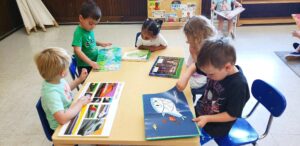
Have you noticed how quickly children recognize a red apple or a yellow duck, but still take time to remember letters? This happens because young children naturally respond to visuals. Colours attract their attention first, while letters take more repetition and practice.
When learning the alphabet and colours together, children understand things more easily. Instead of seeing letters as separate symbols, they connect them with familiar objects and colours. This simple link makes early learning smoother and more enjoyable.
For parents and teachers, this is an easy method to support early childhood education and build confidence in the first learning stages.
Why Visual Learning Works for Young Children
Children don’t begin with reading or writing. They start by observing the world around them. Bright colours, shapes, and movement naturally draw their attention more than words.
Think of a child reaching for a colourful toy or pointing at a balloon. That curiosity is the beginning of learning. Their brain are constantly trying to understand what they see.
When letters and colours are introduced together, children connect new information with something they already know. This is why visual learning for kids is so effective.Colours also help children stay focused longer, which is important in early development.
How Colours Help Memory
Colours act as natural memory triggers. They give children extra clues to remember what they learn.For example, when a child learns “A for Apple” in red, they are not only remembering a letter.
They are connecting the alphabet, colour, and object together. This makes recall much easier later.That is why many alphabet learning activities use colourful images and objects.
Benefits of Learning Alphabets and Colours Together
When alphabets and colours for kids are taught side by side, children learn in a more connected way. Their brains process visuals and language at the same time.
Key benefits include:
- Better letter recognition
- Stronger colour recognition for children
- Improved memory retention
- Faster vocabulary development
- Higher engagement in interactive learning for kids
- Strong foundation for early literacy skills
Instead of learning in parts, children see everything as one connected idea.
Easier Letter Recognition
Letters can feel confusing when taught alone. But when paired with colours and familiar objects, they become much easier to understand. For example, “B for Blue Bird” helps children quickly recognize the letter B because the image supports memory.
Stronger Early Literacy Skills
Early exposure to letters builds the base for reading and writing. When children connect sounds, letters, and visuals, they slowly develop literacy skills for preschoolers without pressure. It happens naturally through repetition and recognition.
Vocabulary Development
Children learn new words faster when they can see what they mean.
For example:
- A for Apple
- C for Cat
- D for Duck
These simple associations support vocabulary building for kids and make learning more practical.
More Engagement in Learning
Children learn better when it feels like play. Bright colours and familiar objects keep them interested. This is where learning through play becomes important. When children take part instead of just watching, they stay more focused and remember more.
How This Helps in Kindergarten Readiness
Preparing children for school doesn’t always require advanced lessons. It starts with a basic understanding. When children already know the alphabet and colours, they adjust more easily to classroom learning.
They follow instructions better and feel more confident in group activities. This early exposure supports kindergarten readiness and makes school transition smoother.
Simple Ways Parents Can Support Learning at Home
Learning doesn’t need to be formal. Every day of life offers many teaching moments.
Read Together Every Day
Reading builds strong habits. A simple preschool learning book with letters, colours, and pictures helps children learn naturally.
Use Everyday Situations
Ask your child to find colours around the house or identify letters on signs. These small moments strengthen early learning skills without pressure.
Learning Through Play
Play is one of the strongest tools for learning. Activities like colouring, puzzles, and matching games help reinforce alphabet recognition and colour learning.
Why Educational Books Matter
Books play a key role in early education. A good children’s learning book presents the alphabet and colours in a simple, visual way.
Many educational books for toddlers combine both because it improves understanding and memory.
Books like Learn Alphabets and Colours With Me introduce the A–Z alphabet with colours and illustrations, helping children connect learning with real-life objects.
Conclusion
Learning the alphabet and colours together gives children a strong start in early childhood education. It supports memory, builds vocabulary, and helps develop early reading skills. Most importantly, it keeps learning enjoyable instead of making it feel like pressure.
With small daily activities, play-based learning, and the right educational books for kids, parents and teachers can support a child’s growth from the beginning. These small learning moments slowly build confidence and understanding over time. If you want to make early learning more engaging, you can start with Learn Alphabets and Colors with Me by Nishita Patel, and help your child take their first steps into alphabets, colors, and everyday learning.